
Competency-Based Education in Practice: How CPLED Designed and Implemented a Competency-Based Bar Admission Training Program
Author: Paul Manning, LL.B., LL.M., CPLED Supervisor, Learning & Evaluation
This is the second article in a three-part series on competency-based education (CBE) in lawyer licensing and professional formation. The first article explained what CBE is and how CPLED’s Practice Readiness Education Program (PREP) is helping shape the future of lawyer licensing. This article uses PREP to explore how a competency-based approach informs program design, learning, and assessment.
Introduction
Competency-based education begins with a clear understanding of what learners must be able to demonstrate, as noted in the first article in this series. CPLED’s Practice Readiness Education Program (PREP) provides a practical example of how that principle can be translated into the design and delivery of a bar admission training program.
PREP has been competency-based since its launch in 2020 and is now the official bar admission training program for the law societies of British Columbia, Alberta, Saskatchewan, Manitoba, Nova Scotia, and Nunavut. In 2024, a group of law societies validated the Competencies for Entry to Legal Practice (CELP), formerly the Western Canada Competency Profile (WCCP), which define the competencies required of lawyers entering practice. PREP’s established competency-based approach provided a strong foundation for its subsequent alignment with CELP.
Drawing on CPLED’s experience developing, refining, and delivering PREP, this article examines how a competency-based approach is put into practice, from program and assessment design to the progressive development and demonstration of competence. At the centre of this approach is the distinction between knowing the substantive law and being able to demonstrate legal skills, and apply legal knowledge effectively, ethically, and appropriately in practice.
History of PREP’s Competency-Based Framework
CPLED began developing its competency-based framework in 2018. From 2018 to 2020, it created PREP’s original competence levels and rubrics in consultation with practising lawyers, education experts, and a psychometrician specializing in educational measurement. The framework identified three broad skill areas that entry-level lawyers should be able to demonstrate: (1) oral skills, (2) written skills, and (3) ethics, client relationship management, and practice management skills. An early step in developing PREP was then mapping course content and assessments to this competency framework.
PREP’s Alignment with CELP
On October 1, 2025, CPLED’s Board of Directors formally adopted CELP, formalizing the transition from PREP’s existing competency framework to the new framework.
The next step in aligning PREP with CELP was to map the existing competency-based program against the Competencies for Entry to Legal Practice and implement the resulting changes.
CELP identifies seven domains:
- Ethics and Professional Responsibilities
- Communication
- Truth and Reconciliation
- Professional Relationship Management
- Critical Thinking and Analysis
- Advice and Advocacy
- Practice Management and Well-being
Across these domains, 25 competencies and 86 performance indicators describe what newly called lawyers must demonstrate to enter practice. Although CELP introduced some new performance indicators, it aligned strongly with the PREP Competency Framework.
As of May 2026, PREP is fully aligned with CELP, meaning that all curriculum and assessments in PREP are now informed by CELP, ensuring students are trained and assessed against a modern, validated set of competencies.
PREP Structure
PREP consists of four progressive phases. The first three give students repeated opportunities to develop the foundational skills and competencies required for entry-level legal practice, while the fourth formally evaluates their competence in the three broad skill areas identified above.
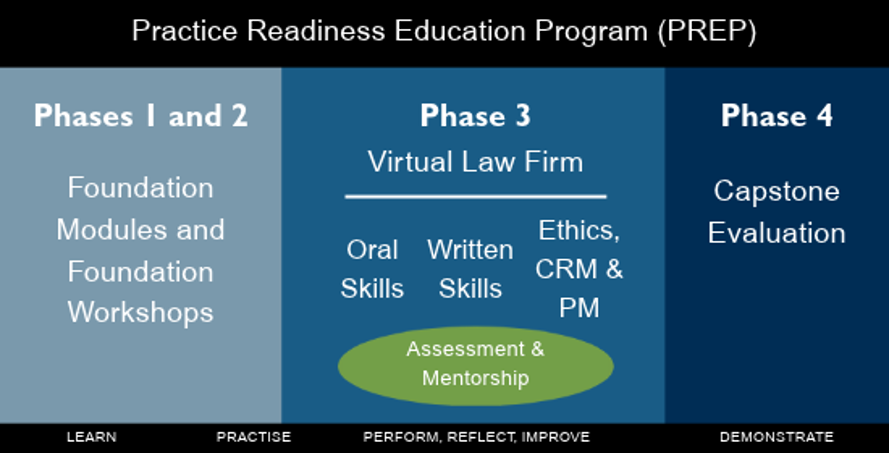
In Phase One, the Foundation Modules, students complete 12 self-directed online modules that introduce, reinforce, and build a solid foundation in CELP.
In Phase Two, students complete five skill-building workshops interspersed with the Phase One Foundation Modules, allowing them to immediately apply the skills introduced in the modules. The workshops cover key competencies in ethics, client relationship management and professionalism, client interviewing, legal drafting and writing, negotiation, and oral advocacy.
In Phase Three, the Virtual Law Firm (VLF), students handle simulated legal matters and communicate with fictional clients (played by real people) and supervising lawyers. The simulated environment gives students opportunities to practise professional skills, make decisions, receive feedback, and continue developing their competence, alongside or in advance of commencing articles. They complete 16 assignments in business, criminal, and family law. Although the assignments assess some substantive legal knowledge, their primary focus is on developing and demonstrating the skills and competencies required for entry-level practice.
Across Phases One to Three, students work with increasingly complex material. By Phase Three, their competencies are formatively assessed in oral and written communication, research, ethics, client relationship management, and practice management.
In Phase Four, the Capstone Evaluation, students are formally evaluated to determine if they have achieved the required competence level to complete the program and satisfy a key component of their law society’s requirements. In this final phase, students complete nine assignments using simulated legal matters that comprehensively assess competencies across the three skill categories identified through the initial framework mapping: (1) oral skills, (2) written skills, and (3) ethics, client relationship management, and practice management.
To pass the final Capstone Evaluation, students must demonstrate the program’s required standard of “entry-level competence” in each of the three skill categories and across all categories.
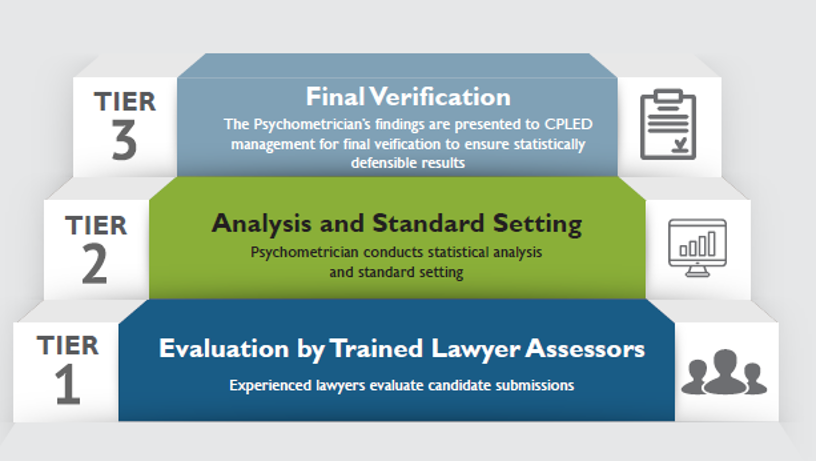
Because PREP is a professional program mandated by law societies, its pass/fail decisions must be based on a rigorous, defensible process. CPLED therefore developed a three-tier review process for the final Capstone Evaluation.
- Tier 1 – Trained lawyer-assessors grade each student’s assignments using the assessment criteria and rubrics described below. To ensure consistent marking, assessors complete calibration sessions and receive detailed evaluation guides.
- Tier 2 – A psychometrician, an educational measurement specialist, analyzes grading data and aligns scoring standards across Capstone Evaluations.
- Tier 3 – CPLED management reviews and verifies the results.
For each Capstone Evaluation, CPLED develops original, realistic assignments reflecting the work expected of entry-level lawyers across the three skill categories. Each Capstone includes three oral assignments: a simulated client interview, a peer-to-peer interest-based negotiation, and an oral advocacy submission. Written assignments assess legal writing, drafting, and research, as well as students’ ability to identify and address issues involving ethics, client relationships, and practice management. To demonstrate effective time management skills, consistent with the realities of legal practice, students must complete all six written assignments and video-record all three oral assignments within a set timeframe to demonstrate the required entry-level competencies.
Adult Learning and the Spiral Curriculum
PREP applies adult learning principles by treating candidates as developing professionals who build competence by connecting new knowledge to realistic tasks, receiving feedback, reflecting on their performance, and applying their learning in increasingly complex contexts. One way PREP puts these principles into practice is through its spiral curriculum, which builds candidates’ skills progressively through repeated practice and feedback from simulated clients and experienced lawyer contractors.
Candidates are first introduced to concepts and expectations, then practise skills in workshops, apply those skills in simulated legal matters, and ultimately demonstrate their competence in the final program evaluation. This approach supports self-directed learning, repeated practice, interaction with peers and facilitators, individualized feedback, reflection, and the transfer of learning to articling and entry-level practice. By progressively increasing the complexity and independence expected of candidates, the approach reflects how skills develop in professional practice. In a professional licensing program, this progression allows candidates to demonstrate not only what they know, but how they apply that knowledge through professional judgment, communication, file management, ethical decision-making, and practical lawyering skills.
Example: How PREP Assignments Assess CELP
A Virtual Law Firm Legal Writing assignment illustrates how PREP assesses CELP. For example, students could be asked to draft a legal memorandum concerning a client charged with aggravated assault, identifying relevant legal issues, and providing the supervising lawyer with the information needed to prepare for the first client meeting.
The Legal Writing (Legal Memorandum) Assessment Criteria comprises 11 criteria addressing memorandum structure, a descriptive subject line, an informative introduction, relevant facts and issues, the summary of findings, the identification and analysis of relevant law, the conclusion, proper citation, audience awareness, and effective legal writing. The required components to demonstrate competencies in the Legal Writing (Legal Memorandum) Assignment align to several of the CELP. For example:
| CELP Domain, Competency, and Performance Indicator | Required Components in Legal Writing Assignment |
| Domain 2: Communication 2.1 Deliver clear and audience-centric communications Performance Indicators • Use plain language • Use appropriate and logical organization and structure for communications • Express concepts concisely, precisely, clearly and logically | “Facts” Criterion • Clear, concise, and logical writing “Audience” Criterion • Use plain language at a level appropriate for the end-reader • Use correct level of formality for the end-reader “Effective” Legal Writing Criterion • Write clearly and concisely • Create and use defined terms consistently • Appropriate use of headings to logically divide the submission |
| Domain 5: Critical Thinking and Analysis 5.1 Collect and evaluate all pertinent information 5.2 Conduct legal research 5.3 Perform legal analysis and develop strategy Performance Indicators • Identify relevant legal, practical or client issues • Confirm, verify existence of, and note up case citations and legal authorities • Interpret and evaluate substantive common law, statutes, regulations, rules, procedural matters, policy and theory • Perform legal analysis and develop strategy • Apply techniques of legal reasoning and argument to the findings or information gathered • Draw reasonable conclusions considering the legal issues, relevant facts, and applicable law • Clearly and accurately report research process and findings | “Facts” Criterion • Fact section identifies relevant facts (excludes irrelevant facts) “Issues” Criterion • Issues set out as questions, specifically worded to the situation rather than a general statement “Law” Criterion • Relevant law and principles explained sufficiently for each legal issue • Jurisdiction, priority, and applicability of case law considered • Adverse authorities identified (where applicable) “Analysis” Criterion • Law applied to the specific facts of the client’s case • Thorough analysis for each legal issue • Analogy and distinction (how the law is similar/different from the facts) • Sufficient and clear explanation of the application of the legal test and/or principles to the facts “Conclusion” Criterion • Conclusion for each legal issue that logically flows from the legal analysis • If appropriate, includes a practical recommendation for next steps “Citation” Criterion • Properly cites all sources as per the McGill Guide or COAL • Pinpoint footnote citations |
PREP Competence Levels
As noted above, students complete 16 assignments in the VLF phase and nine assignments in the Capstone Evaluation phase. The assessment framework includes five competence levels outlined in the table below, required components and learning outcomes, criteria that define each skill, and performance indicators that describe the behaviours that demonstrate each criterion.
The same competence levels apply in both the VLF and Capstone phases, and each assignment includes criteria for assessing the relevant competencies, supported by detailed learning outcomes and performance indicators from the competency framework. These measures help students identify their strengths and areas for improvement while giving assessors objective standards for evaluating performance. CPLED adopted the following indicators for each competence level:
| Competence Indicators | |||
| Competency Level | Competency Rating | Competency Summary | Competency Description |
| Incomplete (INC) | 0 | Not yet competent | The assignment was not submitted, submitted after the deadline, or the wrong assignment was submitted. |
| Limited Competence (LC) | 1 | • The student demonstrates limited awareness of the competency. • The student requires supervision and shows inconsistent adherence to established standards of practice. • The student requires significant guidance and support, and the submission requires significant changes to meet the entry-level standard. | |
| Developing Competence (DC) | 2 | • The student demonstrates an increasing awareness of the competency. • The student applies the competency to a simple situation in a standard way and struggles with complex or unusual contexts. • The student can perform the skill with some guidance and increasing independence. • The submission requires moderate changes to meet the entry-level standard. | |
| Entry-Level Competence (EC) | 3 | Competent | • The student demonstrates understanding of the competency and its applicability to relevant contexts. • The student applies the competency to situations of moderate scope and complexity and performs routine tasks independently. • The submission meets the entry-level standard although minor revisions may be required before the document can be used in practice for its intended purposes. |
| Skilled Competence (SC) | 4 | • The student demonstrates a mature understanding of the knowledge related to the competency. • The student applies the competency independently, in difficult contexts, solves problems and considering the application of the competency beyond the basic fact pattern. • The submission exceeds the entry-level standard and can be used in practice for its intended purposes without revision. | |
Conclusion
The Practice Readiness Education Program (PREP) demonstrates how competency-based education can be put into practice within a lawyer licensing program, from curriculum and learning design to the development of assessments, to progressive skill development, authentic practice, feedback, and the final evaluation for successful program completion. Its alignment with CELP builds on that foundation by connecting each stage of the program to a shared understanding of the competencies required of lawyers entering practice.
By giving candidates structured opportunities to apply their knowledge, develop professional skills, exercise judgment, and demonstrate competence, PREP helps make the transition from legal education to practice more deliberate. Professional formation continues throughout a lawyer’s career, and competency-based licensing provides a foundation for that continued development. Together, these elements demonstrate how PREP can serve as a practical and effective competency-based component of the lawyer licensing process.